
Hams of any age know amateur radio can be a rather expensive endeavor, especially when you think about how quickly the equipment costs can pile up. This can be a major obstacle for young hams just starting to explore the hobby, but fortunately there are solutions to this problem and resources to take advantage of.
One of the most impactful of these resources is Remote Ham Radio (RHR), or more specifically, the designated stations young operators can access for free. To qualify for this access, you must hold an FCC amateur radio license, be 21 years old or younger, and receive permission from your parents or guardians.
The signup process is not complicated. Simply fill out a questionnaire on the RHR website asking for your name, callsign, and birthday (for age verification). Then upload an official copy of your amateur radio license. After filling out this form, eligible applicants will be granted a youth membership to RHR with access to more than ten stations that are solely for use by youth members. Stations cover a wide geographical area, including a few in Europe and a number in the U.S. You may operate remotely as allowed by your license class privileges.
All of the equipment necessary to be able to operate from these stations is set up and maintained by the owner of the station, which means the only equipment you need is an electronic device with internet access. You can use anything from your cell phone to your family’s desktop computer, a laptop to an iPad. If using your family’s desktop, headphones may be strongly encouraged and likely to be requested by your siblings. You also won’t need to install any new software to use the program—it simply runs in your browser (and is supported by most commonly used browsers).
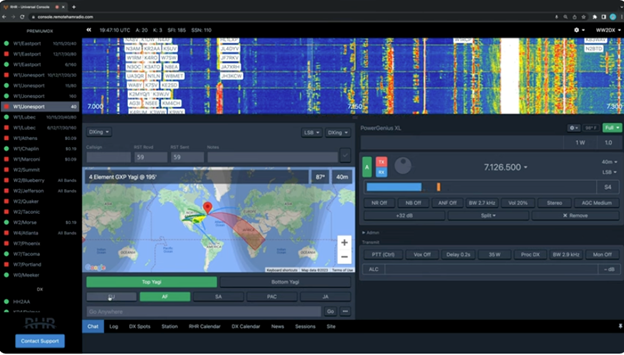
Editor’s Note: RHR remote stations use FlexRadio transceivers integrated with SmartSDR software. Here is what the RHR console looks like when powering up the radio.

Watch the video below on how to accomplish 2M moonbounce (EME) using RHR remote technology.
Using these remote stations is also very simple. From the “console” on your electronic device, you’ll see a waterfall display, as well as all the settings you’d see on an actual radio. For SSB operating, you click the transmit button and use your device’s microphone (or, of course, an external microphone). For CW operating, the console offers several convenient and changeable presets.
For example, if you wanted to participate in a contest, you can edit the CQ message to match that of the contest and the exchange to match your information. There is also a function where you can type the CW that you’d like to be sent, since sometimes the presets can’t cover everything you may want or need to send. For logging, you don’t have to install any other logging software either—there is a built-in logging system, which can be very helpful as well. Finally, when you’re finished operating, you simply click the disconnect button in the top right of the console.
The youth RHR stations can be a great option if you’re hoping to start contesting but can’t get your hands on the proper equipment, or if you’re just looking to get on the air more. It is also an incredibly helpful resource if you’re traveling and don’t have room to bring a lot of equipment but still want to be able to get on the air. I found myself using the program quite often as a fast and efficient way to get on the air for the first few months of my study abroad when I didn’t have enough time to set up my portable station. I’m sure I’ll be using it more often when I start college next year.
In addition to being an incredible resource for getting on the air, the RHR youth program can help you join a network of young amateur radio operators around the world who are interested in improving their skills like you. The console provides access to real-time chat that lets you talk with other young hams connected to the stations, as well as a discord and other groups to facilitate the exchange of tips and ideas between users of the stations—and to just have fun.
The RHR youth program is a great resource for young amateur radio operators. It opens doors to operating and making friends and connections as well.
The post Ham Radio Youth Insights: How to Get the Most Out of Remote Station Access appeared first on OnAllBands.