
Yes, you can.
VHF and UHF are often underrated for DX contacts because hams have long believed they’re just for local use. From the very beginning, new operators are taught a simple rule: HF goes far, VHF and UHF go as far as you can see. While VHF and UHF are usually line-of-sight bands, the atmosphere has never been particularly concerned with following this philosophy.
DX as a concept grew up on HF, and HF still gets most of the attention. Awards, contests, magazine covers, and DXpeditions overwhelmingly focus on HF bands. A rare entity on 20 meters earns applause; the same entity on 2 meters earns a polite nod. VHF/UHF DX quietly became the hobby’s “advanced elective,” taken only by those who enjoy reading footnotes and building antenna arrays larger than their vehicles.
HF gets sunspots, ionospheric layers, charts, predictions, and discussions involving acronyms. VHF/UHF, not so much. The many exceptions—tropospheric ducting, sporadic-E, meteor scatter, aurora, aircraft scatter, and Earth-Moon-Earth (EME) happen, but you’re not supposed to expect them. As a result, many operators assume VHF/UHF DX is either mythical or requires operation during a full moon.
Finding & Working DX
For most amateurs, VHF/UHF means local nets, commute chatter, and emergency communications. All of that is valuable, but it has also become the spectrum’s identity. Weak-signal work using SSB, CW, or digital modes exists in a parallel universe that many operators never visit. To them, the idea of working DX on 2 meters sounds about as plausible as fishing for bass in a swimming pool.
VHF/UHF DX is commonly associated with towering Yagis, mast-mounted preamps, and powerful amplifiers. While these stations exist—and their owners will gladly show you photos— this is not a minimum requirement. During strong tropospheric ducting or sporadic-E openings, modest stations with simple antennas can achieve impressive DX contacts.
Another reason VHF/UHF DX is underrated is that it won’t operate on a schedule. HF allows you to plan; choose a band, consult some charts, and expect results. But VHF/UHF DX openings can appear suddenly and last only minutes rather than hours. Success means watching beacons, monitoring clusters, and calling CQ, even when the band seems empty. Some operators would rather tune a busy HF band than study a quiet VHF waterfall.
DX requires two people paying attention simultaneously, which is easy on HF but much harder on VHF/UHF. Weak-signal VHF frequencies can sound like a ghost town outside of contests. This leads to a classic feedback loop: No one is ever on, so no one listens, which ensures that no one is ever on. When an opening does occur, it may go unnoticed, like a party where everyone stayed home because they assumed no one else would show up.
There is also a psychological barrier. HF antennas are often forgiving and omnidirectional. VHF/UHF DX encourages pointing antennas, turning rotators, and thinking about geography. This requires effort and intent. Some operators love this, others don’t. The moment you have to ask, “Which way is that grid square?” you have already crossed into a different operating mindset.
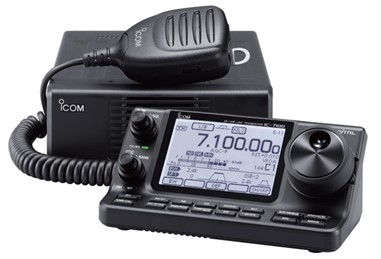
Finding a VHF/UHF DX-capable radio is relatively easy. Just about all current radios cover 6m VHF. A few radios also support the 2m and 70cm bands, including the Icom IC-9700 and IC-7100, and Yaesu FTX-1 and FT-991A. Classic models include Kenwood TS-2000, Yaesu FT-847, and the Icom 706 MKIIG.

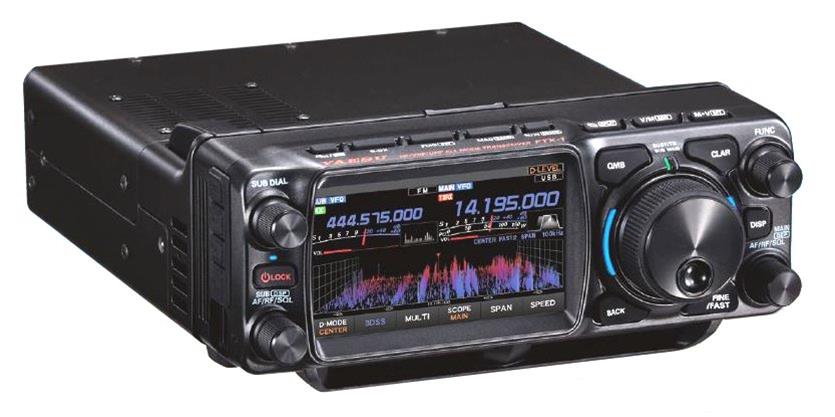
For QRP applications, look at the Yaesu FT-817, Icom IC-705, and Yaesu FTX-1 Field. Theoretically, you can use FM mobile radios for digital modes with a computer. However, it isn’t the best solution—you’d probably get better results with FM by mountaintopping.
Why VHF/UHF Bands Behave So Differently
Just as each HF band has its own set of characteristics and quirks, so do VHF/UHF bands. You need to become acquainted with them to truly appreciate DX on the higher bands. Here are the three most widely used.
6 Meters (50 MHz): The “Magic Band”
Six meters sits in the awkward location between HF and VHF, and it behaves accordingly. Sometimes it acts like HF, spanning continents. Other times it’s stone-dead and ignores you completely.
It earns the nickname the “Magic Band” because when it opens, it really opens. Sporadic-E (Es) can turn a quiet band into a global bash in minutes. Contacts of 1,500–3,000 km are common during the Es season, and multi-hop Es can extend them much farther. F2 propagation can make appearances near solar maximum, enabling accurate intercontinental DX with modest power and antennas.
The downside is there’s no warning. Six meters can go from dead silence to chaos faster than you can rotate your antenna. It rewards people who call CQ while everyone else is checking social media or consulting DX Summit for spots.
Why is 6m underrated? It’s too weird for HF purists and too unpredictable for VHF traditionalists. It also has a cruel sense of timing.
2 Meters (144 MHz): The “That’s Not Supposed to Happen” Band
Most hams consider 2 meters repeater territory. DX on 2 meters sounds implausible—until you work a station 800 km away on SSB during a tropo opening and stare at the map in disbelief.
Tropospheric ducting is the star here. Temperature inversions can form radio “tunnels” that carry signals far beyond the horizon, especially over water or flat terrain. Distances of 500-1,000 km are routine during good conditions, and some ducts can go much farther.
Meteor scatter also shines on 2 meters. With digital modes like MSK144, brief pings from meteors enable contacts between stations hundreds or thousands of kilometers apart—often during daylight.

Why is 2m so underrated? It’s because many hams are too busy using repeaters to realize the band quietly turns into a DX band several times a year.
70cm (432 MHz): The “Serious Operators Only” Band
At 70 centimeters, the excuses start. Higher path loss and greater sensitivity to obstructions make DX more complicated but not impossible.
Tropospheric ducting works here too, often extremely well during strong tropospheric events. Aircraft scatter can also produce surprising results, and meteor scatter is viable with modern digital modes. When conditions align, 70cm can deliver distances that feel borderline illegal.
Why is 70cm usually underrated? It demands more precision. But for operators who enjoy squeezing every ounce of performance from their systems, it’s incredibly satisfying.
Overlooked Opportunity?
Ironically, digital modes have made VHF/UHF DX easier than ever. FT8, MSK144, and other related modes can extract signals buried in the noise. Meteor scatter contacts, once reserved for specialists with stopwatches and extraordinary patience, are now routine. Yet this revolution happened quietly. HF got the headlines; VHF/UHF got the upgrade without the marketing campaign.
Like the HF bands, you find DX stations at the lower ends of the band, in the so-called weak signal segments. On 6 meters, for example, 50.0-50.3 MHz is where Morse code and SSB calling frequencies are located. Similar segments exist on all other VHF and UHF bands, extending into the microwave frequencies.
When you’re DXing on VHF or UHF, use the calling frequencies or set your radio to scan the lower end of the band and leave it on. Propagation between distant points is often short-lived. Set your squelch control so the radio is barely quieted. If anything shows up, the radio will quickly spring to life. This way, you don’t have to listen to continuous receiver hiss and random noise.
For this type of DXing, it’s best to use a small beam antenna. They’re easy to build, relatively small compared to HF antennas, and a terrific homebrew project. Mount the antenna for horizontal polarization. Adding a cheap TV antenna rotator will let you easily change the beam direction. Signals may appear from anywhere at any time.
To find out more about current VHF/UHF propagation and DX, check out these resources:
- DX Info Centre Tropospheric ducting forecasts using regional maps.
- “VHF/UHF Handbook VHF2”: Many topics are covered, including propagation and DX.
- VHF Propagation Path Profiler. This is a comprehensive application that allows you to render graphically and mathematically various VHF/UHF propagation metrics between any two point-to-point locations on the Earth’s surface.
Exotic Propagation
Chances are you’ll rely on Es and tropo propagation, which occur year-round, mainly in the early summer and winter months. But don’t overlook some other interesting propagation modes.
- Aurora: It’s a large ionized structure in the ionosphere, which is oriented vertically instead of horizontally, like sporadic E, but still reflects signals. When an intense aurora is present, it can reflect VHF and UHF signals over a wide area. One of the most incredible things about aurora propagation—it adds an audible signature to the signals it reflects.
- Meteor Scatter: Signals are reflected from the tens of thousands of meteors that enter the Earth’s atmosphere. Friction that’s produced as the meteors burn up ionizes the gas molecules. These molecules reflect radio signals, so two stations having the meteor trail between them can communicate for a short time, maybe a minute or so at maximum. If you’d like to know more about this mode, check out www.meteorscatter.org.
- Mountaintopping: When DXing doesn’t provide you with an over-the-horizon path, move your horizon! VHF/UHF radios are lightweight, and the antennas are relatively small. This makes it easy to carry your gear to the tops of buildings, hills, ridges, or mountaintops.
The higher the elevation, the farther your signal travels without help from the ionosphere, weather, or other means. You can see for miles from the tops of many hills, and the radio can see even more. These expeditions are often popular in VHF contests.
Summits On the Air (SOTA) encourages activity by these radio-enabled hikers, who often use ultra-low-power gear to make their contacts both challenging and fun. You can read up on SOTA at www.sota.org.uk.
Great Expectations
VHF and UHF are often underrated for DX contacts because amateur radio culture has long framed these bands as “local” rather than “global.” While VHF/UHF propagation is usually line-of-sight, some conditions can—and regularly do—support long-distance communication. As a result, many operators don’t take advantage of VHF/UHF DX, assuming it is either impractical or requires expensive equipment. In reality, it offers some of the most exciting and rewarding operations in ham radio.
DX is possible on the 6m band and up, but it’s often more challenging than the HF bands. Successful operators incorporate modes like SSB/CW/digital, good antennas, and leverage propagation events like sporadic-E (summer) or tropospheric ducting (winter), with moonbounce (EME) as an extreme option. FM is primarily for local communication, but summit-to-summit FM contacts can reach impressive distances.
VHF/UHF DX is commonly associated with long Yagis, stacked arrays, mast-mounted preamps, and high-power levels. Though some operators have them, they aren’t always necessary. During strong tropospheric ducting or sporadic-E openings, modest stations with simple antennas can make contacts over distances of hundreds to thousands of kilometers.
Ultimately, VHF/UHF is underrated for DX because it does not fit the traditional definition of long-distance communication in amateur radio. Instead, it offers some unique challenges and lots of surprises. The “Magic Band” that can be silent one minute suddenly carries signals far beyond the horizon. For hams willing to listen, learn, and experiment, VHF/UHF DX can become one of the most exciting frontiers in the hobby. It proves that the atmosphere has a sense of humor—and it likes to share it.
For the Record
What would DXing be without distance records? On the HF bands, numerous terrestrial distance records were established long ago. However, many frontiers remain in VHF/UHF. Al Ward, W5LUA, has compiled a record list for VHF/UHF/Microwave, with new records added regularly. Here are a few examples.
DX Distance Records for 2M/70cm Bands
| Frequency | Mode | Distance | Call/Grid Square | Date |
|---|---|---|---|---|
| 144 MHz | Aurora E | 2,446 km | NU7Z (CN87ts) – W9RPM (EN43jt) | Oct. 3, 2003 |
| 144 MHz | Meteors | 3,162 km | K5UR (EM35wa) – KP4EKG (FK68vg) | Dec. 13, 1985 |
| 432 MHz | Tropo (A) | 4,442 km | NP4BM (FK68lm) – D4VHF (HK78mj) | Apr. 11, 2020 |
| 432 MHz | Aurora | 1,909 km | WB5LUA (EM13qc) – W3IP (FM19pd) | Feb. 8, 1986 |
The post Can You Work DX on VHF & UHF? appeared first on OnAllBands.