
Plus, find links to more amateur radio satellite videos from DX Engineering.
***
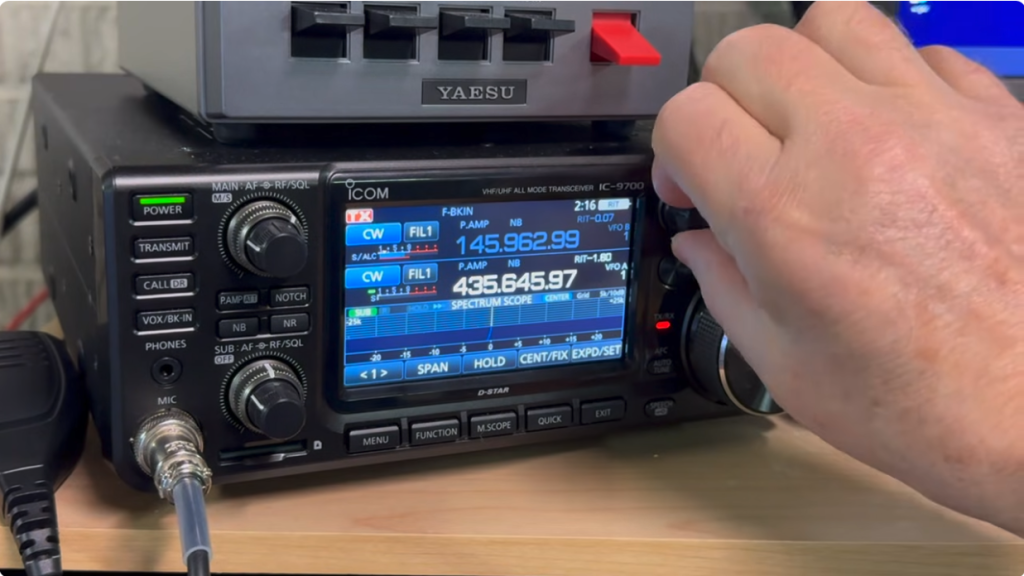
If want to work the “birds” from the comfort of your shack, the Icom IC-9700 VHF/UHF/1.2 GHz Transceiver is the satellite-friendly rig you’ll want to handle the job.

The Icom IC-9700 features full-duplex operation, simultaneous dual-band reception, and an integrated spectrum scope with waterfall, allowing you to transmit on one band while listening to another and visually track weak satellite signals. Its built-in features like normal/reverse tracking, automatic frequency control (AFC), and dedicated satellite memories simplify tracking and operating linear satellites.
Most importantly, the rig’s full duplex and dual receive capabilities let you transmit on the uplink (e.g., 2M) while simultaneously receiving the downlink (e.g., 70cm) on the same radio, crucial for linear transponder satellites like those in the AO-91, SO-50, and VO-6 series. Further, it’s designed for weak-signal work, with a stable power amplifier and efficient cooling for long passes.
From a user standpoint, we’ll let Peter, a DX Engineering customer, explain more from his five-star review:
So, I’ve had this for less than a day. That alone should tell you a lot. The 9700 comes with programming software. Since its cake to hook it up, I went straight to the programming software and input as many satellites as I could. That took about 30 minutes as I wanted to be sure I’d entered the frequencies and tones properly. The software is intuitive and very easy to hook to the radio via USB. The USB CODEC’s auto installed as well.
Once the programming was done, off I went. While I waited, I tried out several repeaters, nothing special about that, easily programmed all the locals with the software upfront. But where the 9700 really shines is on so-called weak signals. I have now worked four different satellites today, several times, and the receive is outstanding.
Operationally, during a pass, it is cake to adjust for Doppler, invert or norm very fast, and it’s EASY to read. The radio works right out of the box with my mast mounted pre-amps. No problem. It’s smaller than my old 9100 and a thousand times easier to operate. I guess I’ll go read the manual now to see what else it may do. I look forward to using it over the internet—now won’t that be cool.
Peter, a DX Engineering customer
In the video below, DX Engineering’s Michael, KI8R, shows you what it takes to build a high-performance base station, primed for satellite success, around the IC-9700. Here are other station components that KI8R mentions:
- M2 Circularly Polarized Beam Antennas
- Yaesu G-5500DC Azimuth-Elevation Rotator
- CSN Technologies S.A.T. Self-Contained Antenna Tracker
Here are links to other KI8R amateur radio satellite videos from the DX Engineering YouTube channel:
- How to Build a Simple Ham Radio Station to Work Satellites—Without Breaking the Bank
- Working Ham Radio Satellites with a Portable Handheld Yagi Antenna
- Ham Radio Satellites 101: Build an Amateur Radio Station and Talk to the Birds

The post How to Build a Base Station for Operating Amateur Radio Satellites Around the Icom IC-9700 Transceiver (Video) appeared first on OnAllBands.